
Bespoke food processing machinery
Solutions designed for every stage of production
Our bespoke food processing machinery is designed to meet the specific needs of various production sectors.
Every solution is developed in-house, using certified materials and with comprehensive quality control at every stage of manufacture. From filling stations to end-of-line systems, we offer reliable, flexible machines that can be easily integrated into production flows.
Request further information
Please fill in the contact form; a member of our team will get in touch with you as soon as possible.
Machinery designed for your production
Our range includes comprehensive solutions for every stage of production, developed in-house and customisable. Reliable, versatile machinery designed to integrate seamlessly into the various processes of the food industry.
Unstacking Machines for Stacked Trays
Lorem ipsum dolor sit amet, consectetur adipiscing elit. Ut elit tellus, luctus nec ullamcorper mattis, pulvinar dapibus leo.
Needle or Suction Cup Demoulders
Lorem ipsum dolor sit amet, consectetur adipiscing elit. Ut elit tellus, luctus nec ullamcorper mattis, pulvinar dapibus leo.
Automatic Tray Filling System
Lorem ipsum dolor sit amet, consectetur adipiscing elit. Ut elit tellus, luctus nec ullamcorper mattis, pulvinar dapibus leo.
Cup-forming machines
Lorem ipsum dolor sit amet, consectetur adipiscing elit. Ut elit tellus, luctus nec ullamcorper mattis, pulvinar dapibus leo.
Bulk Feeders for Flour, Sugar or Salt
Lorem ipsum dolor sit amet, consectetur adipiscing elit. Ut elit tellus, luctus nec ullamcorper mattis, pulvinar dapibus leo.
Cap capping machines, Capping machines,
Lorem ipsum dolor sit amet, consectetur adipiscing elit. Ut elit tellus, luctus nec ullamcorper mattis, pulvinar dapibus leo.
Automatic lid-placing systems.
Lorem ipsum dolor sit amet, consectetur adipiscing elit. Ut elit tellus, luctus nec ullamcorper mattis, pulvinar dapibus leo.
Customised Indexed Conveyor Belts
Lorem ipsum dolor sit amet, consectetur adipiscing elit. Ut elit tellus, luctus nec ullamcorper mattis, pulvinar dapibus leo.
Conveyor Belts on Rollers or Pins
Lorem ipsum dolor sit amet, consectetur adipiscing elit. Ut elit tellus, luctus nec ullamcorper mattis, pulvinar dapibus leo.
Mesh Conveyor Belts
Lorem ipsum dolor sit amet, consectetur adipiscing elit. Ut elit tellus, luctus nec ullamcorper mattis, pulvinar dapibus leo.
Modular Conveyor Belts
Lorem ipsum dolor sit amet, consectetur adipiscing elit. Ut elit tellus, luctus nec ullamcorper mattis, pulvinar dapibus leo.
Box-making machine with automatic box filling.
Lorem ipsum dolor sit amet, consectetur adipiscing elit. Ut elit tellus, luctus nec ullamcorper mattis, pulvinar dapibus leo.
Cartesian robot, 2-axis, 3-axis, 4-axis.
Lorem ipsum dolor sit amet, consectetur adipiscing elit. Ut elit tellus, luctus nec ullamcorper mattis, pulvinar dapibus leo.
Olive Packaging Lines
Lorem ipsum dolor sit amet, consectetur adipiscing elit. Ut elit tellus, luctus nec ullamcorper mattis, pulvinar dapibus leo.
Special production lines and workstations
Lorem ipsum dolor sit amet, consectetur adipiscing elit. Ut elit tellus, luctus nec ullamcorper mattis, pulvinar dapibus leo.
Special production lines and workstations
Lorem ipsum dolor sit amet, consectetur adipiscing elit. Ut elit tellus, luctus nec ullamcorper mattis, pulvinar dapibus leo.
Machinery designed for your production
Our range includes comprehensive solutions for every stage of production, developed in-house and customisable. Reliable, versatile machinery designed to integrate seamlessly into the various processes of the food industry.
Unstacking Machines for Stacked Trays
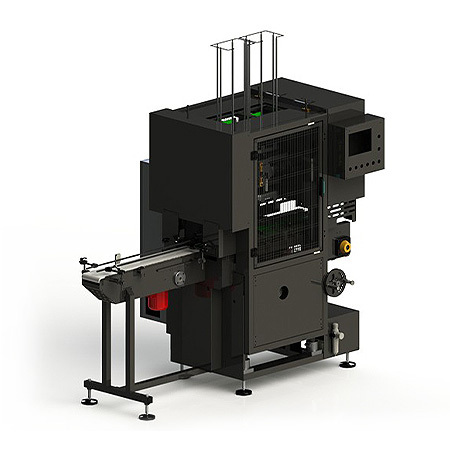
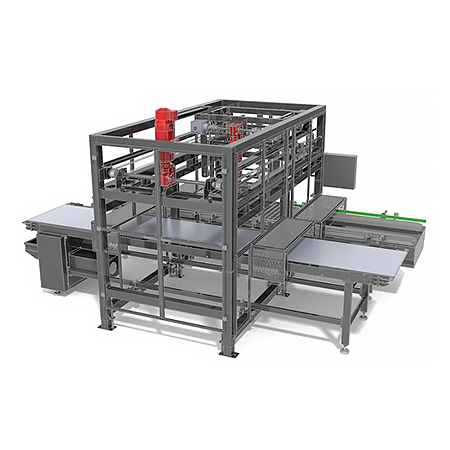
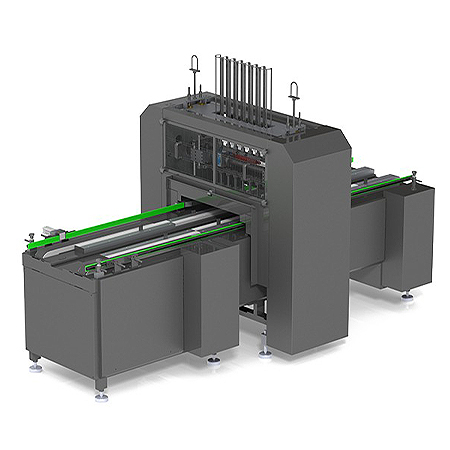
A tray destacker (also known as a denester) is an automatic machine used in packaging lines to remove individual trays from a stack and place them onto a conveyor belt.
Needle or Suction Cup Demoulders
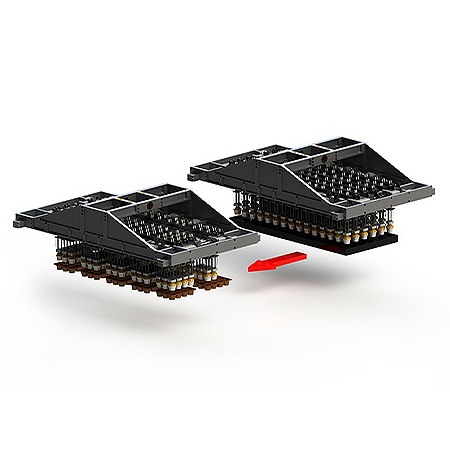
Demoulding (or extraction) systems are broadly divided into two categories, based on the nature of the product to be handled: needles for solids and semi-solids, and suction cups for smooth, non-porous surfaces.
Automatic Tray Filling System
The automatic filling system is the ‘heart’ of the line, situated immediately after the destacker. The choice of technology depends entirely on the product.
Pick & Place Systems
Pick & Place is the fundamental operation in automation whereby a robot picks up an object from one location (e.g. a conveyor belt) and places it precisely in another (e.g. a box or blister pack).
Cup-forming machines
Cup-filling machines are specialised machines designed to pick up and place individual cups (made of paper, aluminium or plastic) into pre-formed trays or directly onto conveyor belts.
Bulk Feeders for Flour, Sugar or Salt
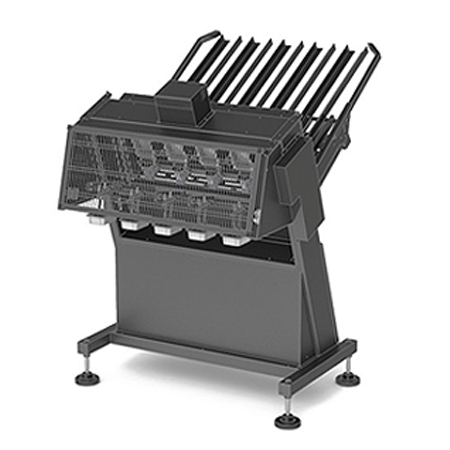
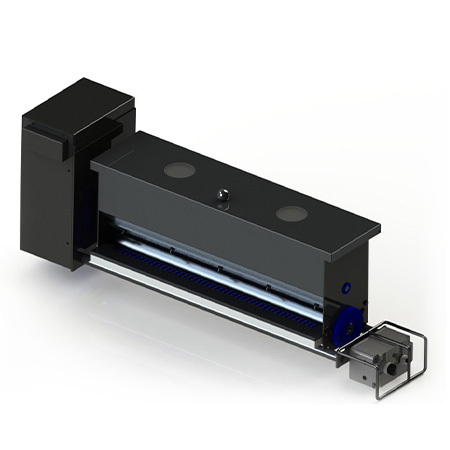
Dusting units (or sprinklers) are automatic devices positioned above conveyor belts to distribute powdery or granular ingredients such as flour, sugar (granulated or icing sugar), salt, cocoa and seeds in a ‘rain-like’ pattern.
Cap capping machines, Capping machines,
Lid capping machines (or capping machines) are automatic machines designed to apply and secure lids onto containers such as trays, jars, tins or buckets.
Pitch Conveyor Belts
Intermittent (or stop-and-go) conveyor belts are handling systems in which the belt does not run continuously, but stops at precise positions to allow for destacking, filling, dusting and capping operations.
Belt Conveyors
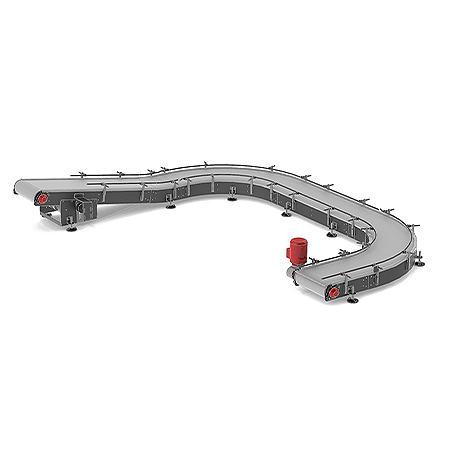
A belt conveyor is a mechanical device used for the continuous handling of goods, bulk materials or packaged products along horizontal or inclined routes. It operates by means of a belt (a closed loop) that rotates around end drums, supported by a frame and driven by a motor.
Wire Mesh Conveyor Belts
Wire mesh conveyor belts are material-handling systems designed to operate in extreme conditions where standard rubber or PVC belts would fail. Their open structure and the material they are made of (usually stainless steel or carbon steel) make them ideal for thermal, chemical and food processing applications.
Modular Conveyor Belts
Modular conveyor belts are material-handling systems comprising individual plastic (or rubber/steel) modules interconnected by pins, forming a continuous chain. Unlike traditional one-piece belts, this ‘brick-like’ structure allows for flexible configurations and makes maintenance much easier.
Multipack Range
A multipack system with two side labels is an automated packaging solution designed to bundle multiple product units (such as trays, bags or boxes) by simultaneously applying two labels to opposite sides. This method often replaces the use of shrink wrap or additional cardboard boxes, offering a more sustainable and cost-effective alternative.
Box-making machine with automatic box filling
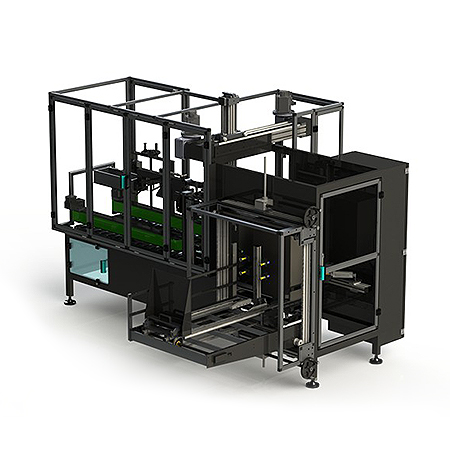
An automatic cartoning machine (or case packer) is an industrial machine that automates the entire end-of-line process: from forming the corrugated cardboard box to inserting the product, right through to the final sealing.
Automatic cartoning machines
Automatic cartoning machines are designed to place products (vials, tubes, bottles, blister packs or sachets) inside pre-glued cardboard cartons and then seal the ends.
Cartesian robot, 2-axis, 3-axis, 4-axis
Cartesian robots (also known as portal or gantry robots) operate along linear axes that are perpendicular to one another (X, Y, Z), following the coordinates of the Cartesian coordinate system. They are the standard choice for controlling the carton-forming machines and case-packing machines discussed earlier.
Special packaging lines and stations
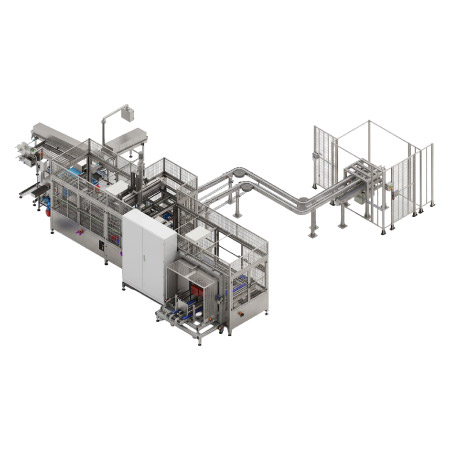
Specialised packaging lines and cells are industrial automation systems designed to handle products that require special treatment or bespoke configurations, which standard machines cannot accommodate. Whilst a line is a sequential series of processes for packaging a product from start to finish, a cell is often a robotic or multifunctional unit dedicated to specific tasks, such as filling or palletising.
