Corkers
The machinery
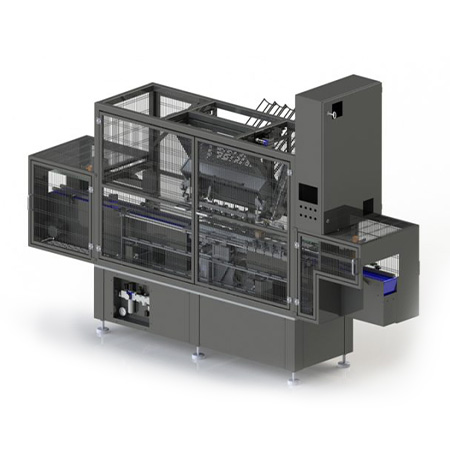
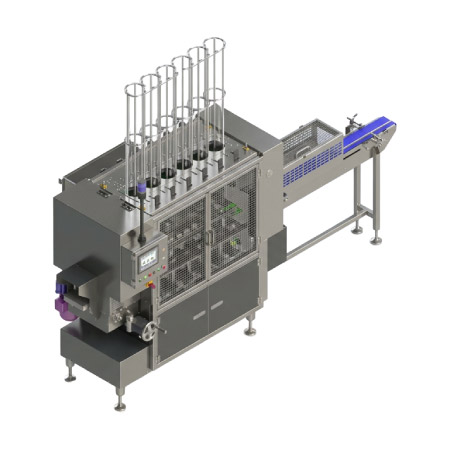
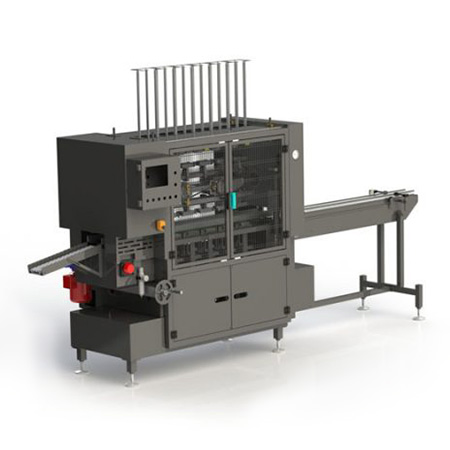
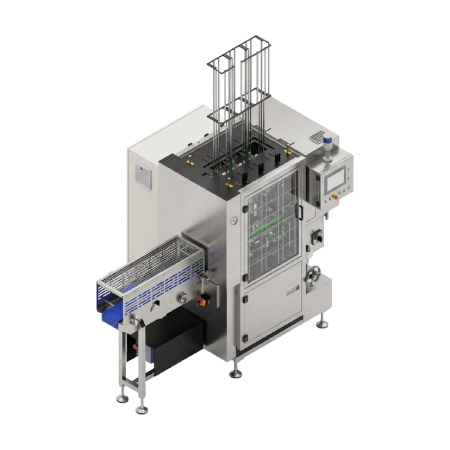
The capping machine, commonly referred to as a “capper” in the food industry, is an effective solution for capping containers of any shape and size. Its compact design and autonomous operation allow it to be integrated into new or existing production lines. The format changeover procedure is extremely simple: dismantling the lid stack magazine and the gripper arm takes just a few minutes, ensuring total flexibility and the ability to switch quickly from one production run to another. The speed variation between the conveyor belts synchronizes the containers with the capping arm, making the machine self-feeding. With a single signal exchange with upstream and downstream machines, integration is complete. The use of Siemens, Omron, Allen-Bradley, and Telemecanique PLCs, along with PROFINET, EtherCAT, EtherNet/IP, and CANopen protocols, allows for integration into any company’s specifications.
Key Features
- Compact and easy to install
- Low maintenance
- High operational flexibility
- Easy to use and clean
- Quick format change
Areas of application
Bellini Machines capping machines are used in a wide range of production sectors, adapting easily to different types of containers and processes. Thanks to their flexibility, they ensure rapid integration into existing production lines and provide effective support for packaging and handling operations.
Bakery
Food
Beverage
Packaging
Cosmetics
Pharmaceuticals
Pet food
Request further information
Please fill in the contact form; a member of our team will get in touch with you as soon as possible.
The machinery
In this section, you’ll find answers to frequently asked questions to help you better understand how our machinery works and the services we offer. Quick and clear support to guide you in choosing and using our solutions.
What is an automatic corker and when is it best to use one?
An automatic capping machine is a machine that retrieves lids from a storage area and applies them to containers moving along the production line, continuously and without manual intervention. It is advisable to use one when production volumes make manual capping too slow, costly or prone to capping defects.
What types of containers and lids does the Bellini Machines capping machine handle?
The Bellini Machines capping machine is designed for containers of any shape and size. Thanks to the quick-change format system, it is possible to switch from rectangular to round trays, or from rigid to flexible lids, adapting the machine to different production requirements.
What is the difference between the TM80/2, TM80/3, TM120/4 and TM120/6 models and the jaw-type capping machine?
The TM80 and TM120 models differ in terms of the width of the conveyor belt (80 mm or 120 mm) and the number of parallel lanes (2, 3, 4 or 6), which determines the hourly production rate. The jaw-type capping machine, on the other hand, is suitable for containers that require a mechanical closure applied from the side, rather than from above.
How does the capper’s automatic feeding system work?
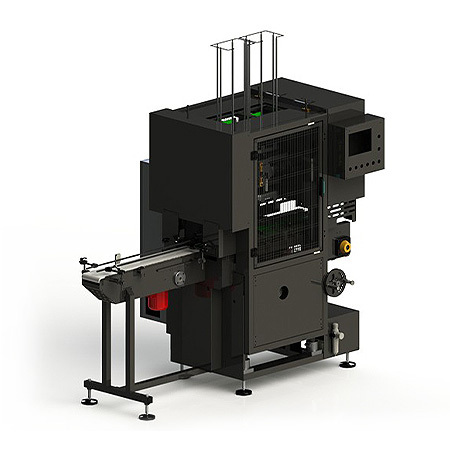
The capping machine is self-feeding: the difference in speed between the conveyor belts automatically synchronises the containers with the capping arm. With just a single signal exchanged with the upstream and downstream machines, integration into the existing line is complete and requires no additional PLCs.
How long does it take to change the format on the capping machine?
Changing the format is quick and easy: dismantling the lid stack magazine and the gripper arm takes just a few minutes, ensuring total flexibility for manufacturers producing multiple product variants on the same line.
In which industrial sectors is the automatic capping machine used?
The Bellini Machines capping machine is used in the bakery, food, beverage, packaging, cosmetics, pharmaceuticals and pet food sectors. It is suitable for any production process requiring the automatic sealing of containers with pre-formed lids.
Can the capping machine be integrated into an existing production line?
Yes. The machine’s compact design and the option to choose between an on-board control panel or centralised control make it easy to integrate into new or existing production lines. The PROFINET, EtherCAT, EtherNet/IP and CANopen protocols ensure full compatibility with any company’s SCADA or MES system.
How difficult is it to clean and sanitise the capping machine?
Ease of cleaning was taken into account at the design stage: the components in contact with the lids are easily removable and accessible. The open structure and the materials used allow for rapid and thorough sanitisation, in line with the hygiene requirements of the food and pharmaceutical sectors.
Does the capping machine require a lot of routine maintenance?
No. Low maintenance is one of the key features highlighted by Bellini Machines. The pneumatic and mechanical components are of the highest quality, and the design is intended to minimise unplanned downtime and simplify preventive maintenance operations.